Heritage Language Learner vs. Second Language Learner: What Bilingual SLPs Should Know
As bilingual speech-language pathologists, we know that there is no single path to becoming bilingual.
Some of us grew up speaking Spanish at home. Some heard Spanish from grandparents or extended family but primarily spoke English. Others learned Spanish in school, through study abroad, through friendships and community, or because we wanted to serve Spanish-speaking clients.
These different experiences have names.
Two terms you may come across in the language-learning literature are heritage language learner (HLL) and second language learner (SLL). While these terms are not necessarily something we need to assign to our pediatric clients, understanding them can help us think about the different paths that bilingual professionals—and the people we work with—may take to a language.
What is a heritage language learner?
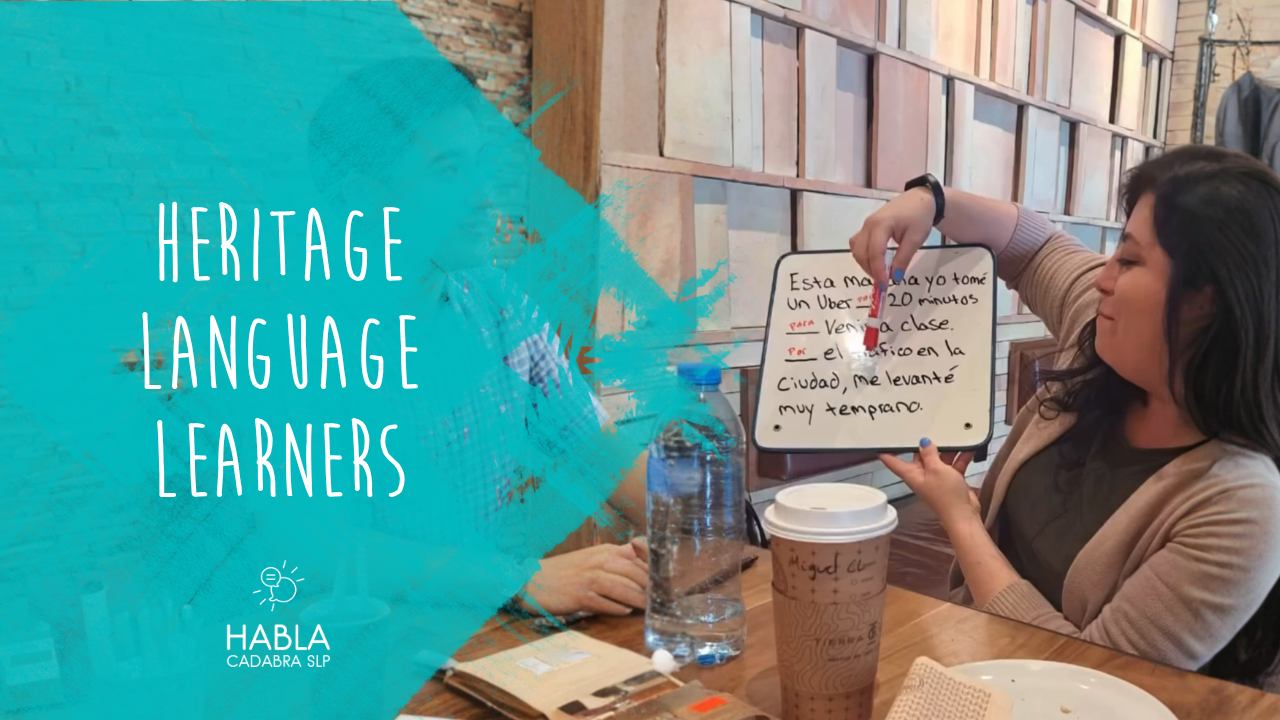
My Spanish is always changing. As a heritage language learner, I grew up with Spanish, but I’ve also spent years intentionally developing my Spanish through relationships, classes, travel, and professional experience. This photo is from a Spanish group I joined in Mexico City.
A heritage language learner is someone who has a family or community connection to a language that is part of their heritage.
In the United States, this often refers to someone who grows up with exposure to a language other than English through parents, grandparents, extended family, or the surrounding community.
Heritage language learners can have very different levels of proficiency.
For example, someone might:
understand Spanish very well but speak it less confidently;
speak Spanish comfortably but have limited literacy in Spanish;
use Spanish primarily with family members;
have experienced a significant decrease in Spanish use over time; or
begin formally studying Spanish later in life to strengthen a language they encountered growing up.
So, heritage language learner does not mean “fluent Spanish speaker.” The term describes a person's relationship and history with the language, not a particular level of proficiency.
What is a second language learner?
A second language learner generally learns a language that was not part of their primary early language environment.
For example, an English-speaking student who begins learning Spanish in high school or college, studies abroad in a Spanish-speaking country, or learns Spanish through formal instruction would generally be considered a second language learner.
Second language learners can also develop very high levels of proficiency. Someone who learned Spanish as an adult may eventually become an extremely skilled Spanish-speaking clinician.
The important distinction is how the language entered the person's life, rather than how proficient they eventually became.
Why does the distinction matter?
Imagine two bilingual SLPs.
SLP A grew up hearing Spanish at home. She spoke Spanish with relatives, attended school in English, and later took Spanish classes to develop her academic and professional Spanish.
SLP B grew up speaking English. She began studying Spanish in college, spent a semester abroad, and continued developing her Spanish through years of clinical practice.
Both may now provide services confidently in Spanish. But they arrived at Spanish through very different pathways.
Those pathways can shape how we experience the language—including our motivation, confidence, anxiety, identity, and reasons for continuing to learn.
A 2014 study by Oh and Nash explored exactly this question in adult Spanish learners.
What did the study examine?
Oh and Nash (2014) compared heritage language learners and second language learners enrolled in a first-semester college Spanish course.
The researchers included 31 heritage language learners and 80 second language learners. Participants completed measures related to their language background, ethnic identity, attitudes, and motivation toward learning Spanish. The researchers then examined how these factors related to language-learning success, using course grades as the outcome measure.
The researchers were interested in three questions:
Did heritage and second language learners differ in their attitudes and motivations?
Were the relationships among these factors similar for the two groups?
Did different factors predict language-learning success for heritage and second language learners?
The results were particularly interesting because the two groups were more similar than different on many of the background measures.
The one significant group difference was parental encouragement: heritage language learners reported greater parental encouragement to learn Spanish.
But when the researchers looked at which factors were associated with language-learning success, the patterns were different.
What predicted success for heritage language learners?
For heritage language learners, two types of motivation were positively associated with success:
Integrative orientation—motivation connected to relationships with Spanish-speaking people and communities, cultural connection, and participation in the Spanish-speaking community.
Instrumental orientation—practical reasons for learning Spanish, such as career or professional goals.
Spanish class anxiety was negatively associated with success.
This is an interesting finding because heritage language learning can involve much more than simply acquiring another language. For some learners, Spanish may be connected to family, culture, identity, community, and belonging and while in some ways that integration can be a positive, there can also be a feeling of pressure or anxiety about your own Spanish performance.
What predicted success for second language learners?
For second language learners, interest in foreign languages was positively associated with language-learning success.
Interestingly, the study did not find that other measures—including motivational intensity, desire to learn Spanish, or general attitudes toward learning Spanish—were significant predictors of success in this sample. The authors note that this finding differed from some previous research.
What does this mean for bilingual SLPs?
For us as bilingual SLPs, the biggest takeaway may be that there is no single path to Spanish.
Some bilingual SLPs are native Spanish speakers, some are heritage language learners, and others are second language learners. And many of us probably fall somewhere in between those neat categories.
Maybe you heard Spanish growing up but didn't use it regularly.
Maybe your grandparents spoke Spanish, but your parents primarily spoke English with you.
Maybe you grew up bilingual but developed your professional Spanish through graduate school and clinical practice.
Maybe you learned Spanish as an adult because you wanted to communicate more effectively with the families you serve.
All of these experiences can lead to meaningful bilingualism.
And none of them makes someone's Spanish inherently more or less valuable.
Why this matters when we support multilingual children
As pediatric SLPs, our job is not to teach children Spanish as a second language.
Our role is to support the languages children need and use to participate in their families, communities, schools, and lives.
That means in order to provide culturally and linguistically responsive services, we want to understand each child's individual language experience:
What languages does the child hear?
Who speaks each language with them?
How often do they use each language?
In which settings?
What opportunities do they have to communicate in each language?
Has their exposure changed over time?
What role does each language play in their family and community?
Understanding the concepts of heritage and second language learning can simply give us another lens for thinking about those histories.
The bigger picture
Language is not learned in a vacuum.
Our experiences with a language are shaped by family, community, culture, identity, opportunity, motivation, and the contexts in which we use it.
Oh and Nash's study is a useful reminder that even two groups of Spanish learners taking the same class can arrive with very different relationships to the language—and those differences may influence their learning in different ways.
For bilingual SLPs, this can be a helpful perspective when reflecting on our own Spanish journeys.
Whether Spanish came to you through your family, your community, your classroom, your travels, or your career, your path to bilingualism is part of your story as a clinician.
And understanding that there are many paths to a language can help us approach the language journeys of the children and families we serve with even more curiosity, humility, and respect.
Reference
Oh, J. S., & Nash, B. A. (2014). Attitudes and motivations of adult Spanish language learners: A comparison of heritage language learners and second language learners. Heritage Language Journal, 11(1), 29–44. https://doi.org/10.46538/hlj.11.1.2