How Can Monolingual SLPs Incorporate Bilingual Supports Into Vocabulary Intervention?
A 2026 study explored whether computer-assisted bilingual vocabulary intervention could help monolingual SLPs support dual vocabulary growth.
If you're a monolingual English-speaking SLP working with Spanish-English bilingual children, you may have wondered:
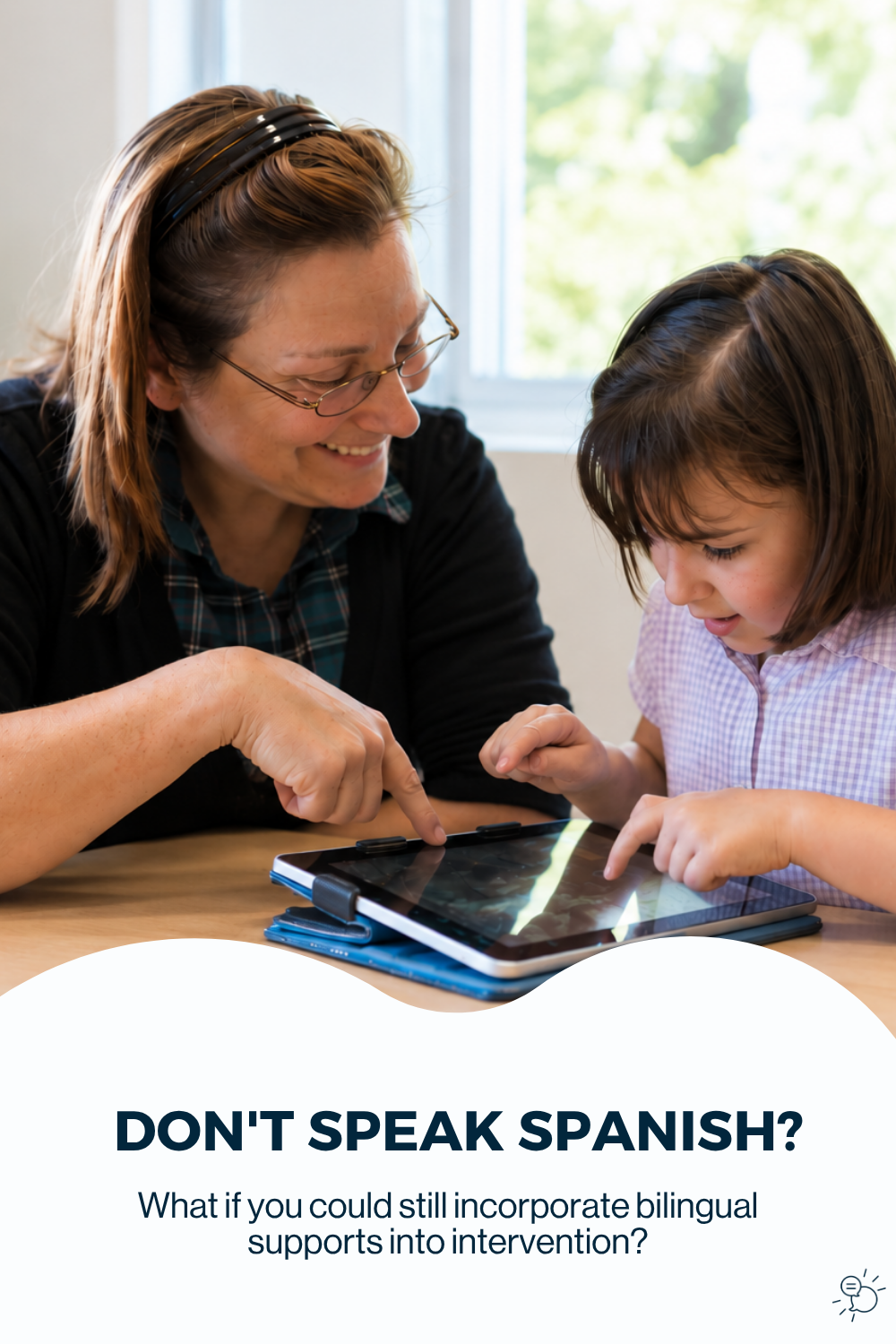
“How can we support bilingual children’s access to learning when we don’t speak their home language?”
For monolingual SLPs, supporting Spanish-English children can feel challenging, not because Spanish has to compete with English, but because we may not know how to incorporate meaningful Spanish supports into intervention.
A 2026 study by Rivera Pérez and colleagues builds on earlier research examining how monolingual clinicians can use technology-supported bilingual vocabulary instruction with Spanish-English preschoolers.
The study found that children receiving bilingual intervention made gains in English while also developing vocabulary in Spanish.
So, what did the researchers actually do—and what might this approach look like in clinical practice?
Why Does Bilingual Vocabulary Intervention Matter?
Vocabulary is foundational for language development and later academic success. For bilingual children, however, vocabulary knowledge develops across two languages. A child may know some concepts primarily in Spanish, others primarily in English, and some in both. This means that supporting only one language may not give us a complete picture of what the child knows or what they are capable of learning.
Bilingual approaches also are crucially important for supporting whole child communication and strengthening the child's home language while promoting English growth.
Maintaining the home language can support:
Communication with family members
Cultural and linguistic identity
Social-emotional development
Participation in family and community life
Continued language development
At the same time, many communities face a shortage of bilingual SLPs.
So how can monolingual SLPs provide meaningful bilingual support when they don't speak the child's home language?
Building on the 2019 Research
If you read our earlier post about using Spanish-English vocabulary support when you don't speak Spanish, this study is a fascinating next step.
In their 2019 study, Rivera Pérez and colleagues examined whether Spanish audio prompting could help monolingual English-speaking SLPs provide vocabulary intervention to bilingual preschoolers.
The Spanish-English intervention group made gains in both languages. The 2026 study builds on that intervention beyond the audio prompting with a more comprehensive Computer-Assisted Bilingual Vocabulary Instruction (CABVI) approach.
The goal was to create a structured intervention that a monolingual clinician could use to provide vocabulary instruction in both languages.
What Is CABVI?
CABVI stands for Computer-Assisted Bilingual Vocabulary Instruction.
The approach combines direct vocabulary teaching, digital storybook reading, and computer-assisted activities with audio support in English and Spanish.
The technology provides:
Target word pronunciation
Definitions
Contextual examples
Digital storybook exposure
Receptive vocabulary activities
Naming opportunities
Definition tasks
While the earlier study provided translations of individual words, the CABVI intervention provides a structured learning sequence across languages.
Who Participated in the Study?
The study included 21 Spanish-speaking preschoolers. The children passed a bilingual language assessment and had IQ and vocabulary skills within normal limits.
The children were assigned to one of three conditions:
1. Bilingual CABVI
Children received vocabulary instruction in both Spanish and English.
2. English-Only CABVI
Children received the same computer-assisted vocabulary intervention, but all instruction was provided in English.
3. Business-as-Usual
Children continued with their regular classroom instruction without the direct CABVI intervention.
The researchers wanted to know two things:
Would bilingual CABVI produce greater vocabulary gains than English-only CABVI or typical classroom instruction?
Could the intervention help children learn vocabulary they weren't directly taught?
That second question is especially interesting.
What Did the Intervention Look Like?
The intervention lasted six weeks, with sessions four days per week.
Each session lasted approximately 40–45 minutes.
The children learned 37 vocabulary words, including a balanced combination of:
Nouns
Verbs
Adjectives
The bilingual group received Spanish instruction on Days 1 and 3 and English instruction on Days 2 and 4.
The English-only group received English instruction on all four days.
Both intervention conditions followed the same basic CABVI structure.
Step 1: Word Study
Each target word was presented using a picture.
The child heard:
The target word
A definition
Three examples of the word used in context
The child then had opportunities to listen and repeat the word. If you have heard about retrieval practice, these activities will sound familiar.
Step 2: Digital Storybook Reading
The target vocabulary was embedded into digital stories, with the six target words appearing at least four times per word. This created another opportunity to hear the vocabulary in meaningful contexts.
Step 3: Receptive Vocabulary Practice
Children completed a drag-and-drop activity in which they matched words to pictures.
This gave the researchers an opportunity to measure whether children understood the vocabulary, rather than simply repeating it.
Step 4: Naming
The child was shown a picture and asked to name it.
This measured expressive vocabulary.
Step 5: Definitions
The child was shown images and asked to provide a definition (e.g. “Tell me about it.” “Tell me something else you know”). Knowing a word isn't just being able to label it. A child who truly understands enormous, for example, should be able to demonstrate something about its meaning.
Results of the Study
Both the bilingual CABVI group and the English-only CABVI group demonstrated significant gains in English vocabulary compared with the business-as-usual group.
And these gains were present at both post-test and follow-up. The bilingual intervention did not result in weaker English outcomes. Children receiving bilingual intervention learned English vocabulary.
The bilingual CABVI group also demonstrated significant gains in Spanish vocabulary. Specifically, children showed gains in Spanish receptive and definition measures. This is something the English-only group did not demonstrate.
So we have two important findings occurring at the same time:
English-only CABVI → English vocabulary gains
Bilingual CABVI → English vocabulary gains + Spanish vocabulary gains
Together, these findings add to research that bilingual intervention can support English vocabulary while also creating opportunities for growth in Spanish. For bilingual children, that means intervention can address communication across the contexts and languages that matter in their daily lives.
What About Words That Weren't Directly Taught?
The researchers also asked whether CABVI could promote indirect vocabulary acquisition.
In other words:
Can children learn words that weren't specifically targeted because they're receiving rich language input around the target vocabulary?
We want children to develop language-learning skills that allow them to pick up new vocabulary from context. And in this study, both intervention groups demonstrated improvement in English vocabulary beyond the directly taught targets.
What Does This Mean for Monolingual SLPs?
It's important to keep the study population in mind when interpreting these findings. The children in this study had typical-range cognitive and language skills and passed a bilingual language assessment. The study did not examine children with DLD, so we can't assume that the same results would apply to children with identified language disorders. However, this research provides an encouraging answer to a very practical problem. You don't have to speak Spanish fluently to incorporate intentional bilingual vocabulary supports into intervention.
The CABVI approach was designed to help monolingual clinicians incorporate structured vocabulary support across English and Spanish. The technology provides the Spanish language models, while the clinician can facilitate the interaction and help the child engage with the vocabulary. This is especially valuable in settings where bilingual SLPs are difficult to access.
Technology is a tool - not a replacement for clinical expertise. The assessment and development of this instruction was completed by bilingual speech pathologists who then trained the monolingual SLPs to carry out the intervention. Whenever possible, monolingual clinicians should still collaborate with bilingual SLPs, qualified interpreters, families, and other Spanish-speaking professionals. The technology supports the SLPs and expands resource access.
Three Things SLPs Can Take From This Research
1. Bilingual support can be incorporated without taking away from English learning goals
The bilingual and English-only CABVI groups made significant English vocabulary gains, consistent with previous research showing that supporting both languages does not hinder or slow English language growth. This could be especially interesting in MTSS or RTI contexts, where we may be providing additional language support before considering whether a child needs a more comprehensive evaluation.
2. Technology could help provide language support when an SLP doesn't speak the child's language
The CABVI approach provides Spanish language models through technology while the clinician remains responsible for the intervention.
This could be particularly useful in settings where bilingual SLPs are limited or where an SLP is working with children who speak languages the clinician does not speak.
3. Collaboration still matters
Technology can provide a language model, but it doesn't know which words are most relevant to a particular child.
For MTSS, classroom support, or intervention planning, collaboration with families, interpreters, bilingual SLPs, and other Spanish-speaking professionals can help us identify vocabulary that is meaningful, functional, and appropriate for the child.
The technology can support the process, but the people who know the child and their language continue to be an important part of the team.
The Bigger Picture
For bilingual children, our clinical question is:
How can we support communication and learning across the languages that are meaningful in a child's life?
The 2026 study adds to a growing body of research showing that supporting both languages does not have to come at the expense of English growth. In this study, children receiving bilingual CABVI made significant gains in English vocabulary while also demonstrating gains in Spanish.
But perhaps the more interesting question for monolingual SLPs is how we can make bilingual support more accessible in the first place. This study offers one possible approach. With technology providing Spanish language models, monolingual SLPs may have another tool for incorporating intentional bilingual support into vocabulary intervention.
At the same time, we need more research. The children in this study had typical-range cognitive and language profiles and passed a bilingual language assessment. We don't yet know how children with language disorders, including DLD, might respond to this type of technology-supported bilingual intervention. I hope future research continues to explore this question with children who have language disorders and across different languages and clinical settings.
Technology may give us new ways to provide language support, but we still need research to understand who benefits, under what conditions, and how these approaches can best be integrated into clinical practice.
Disclosure Note: I currently work with the CABVI Lab, the team behind the study discussed here. I wasn't part of this study or its publication, this post reflects my own reading and interpretation of the research.
References and Resources
Rivera Pérez, J. F. , Lund, E., Abdelaziz, M., & Regalado-Lee, A. (2026). Monolingual clinicians using computer-assisted bilingual vocabulary instruction to promote Spanish and English in dual language learners. Language, Speech, and Hearing Services in Schools, 57(2), 386–405. https://doi.org/10.1044/2025_LSHSS-25-00066
CABVI Lab: https://cabvi.study