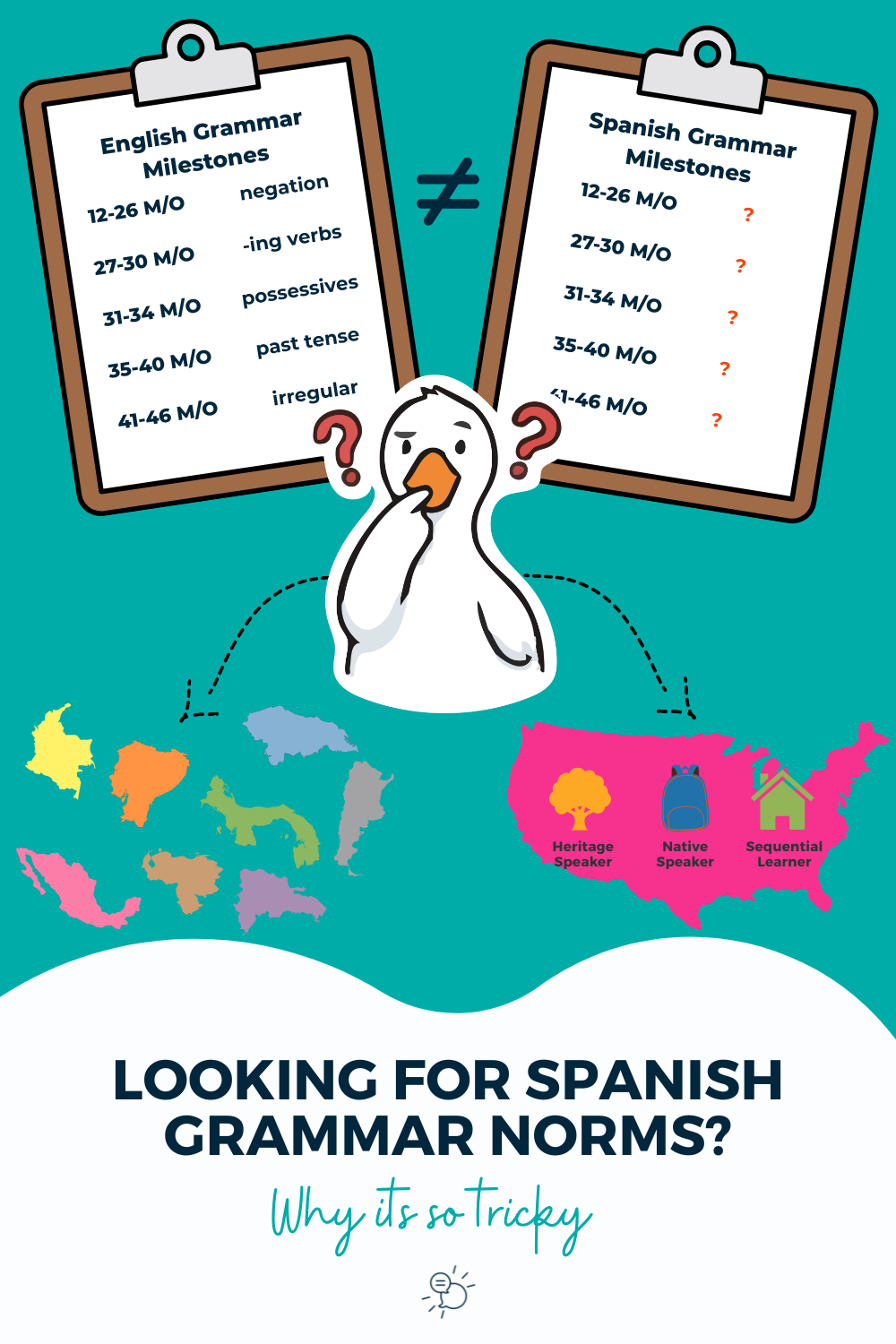
Why Can't I Find Spanish Grammar Norms?
A bilingual SLP recently emailed me with a question that I hear all the time:
"Do you know of a developmental chart with specific milestones for Spanish grammar and morphemes? Something similar to what we have for English?"
And honestly? It's a great question.
It's also one of the most frustrating parts of being a bilingual SLP.
If you've ever searched for information about Spanish developmental milestones or Spanish grammar norms, you've probably found some information about phonological processes and maybe speech sound development…but come up with little on Spanish language development. And when we do find information, it often isn't nearly as specific as the developmental charts we're used to seeing for English.
So why is that?
The Problem Is That Spanish Isn't Just One Thing
When researchers develop norms, they need a relatively consistent group of speakers. That gets complicated very quickly with Spanish. Let's say we wanted to create a developmental chart for plural acquisition. Which children should we include?
Children from Mexico?
Puerto Rico?
Colombia?
Spain?
Guatemala?
All of the above?
Even within the same country, language can vary quite a bit from one region to another.
I was reading a study on plural acquisition in Spanish recently, and one of the interesting findings was that children from two different countries (Mexico vs Chile) showed different patterns of acquisition and comprehension. The difference was that one dialect aspirated or weakened the final /s/, while the other did not. Since plural marking in Spanish often relies on that final /s/, children were receiving different linguistic input from the adults around them.
When the linguistic input differs, we cannot expect acquisition to look exactly the same.
Then We Add Bilingualism Into the Mix
Things get even more complicated when we're talking about bilingual children.
Many of the preschoolers I work with have only recently been exposed to English. For some of them, monolingual Spanish norms might give me a rough reference point, but it would never be the only the only thing driving my decision making. I would need to know more about the family's dialect and language background/use before making any conclusions.
By elementary school, things become even messier.
Some of our students have experienced years of exposure to both languages. Some have parents who speak different varieties of Spanish. Some have shifted language dominance over time. Some are experiencing language loss because they have fewer opportunities to use Spanish.
How do you create a single set of norms for that?
The short answer is: you really can't.
That's one of the reasons we don't have the kind of detailed grammar milestone charts that exist for English.
So What Do We Use Instead?
This is usually the point where people get annoyed with me because they're hoping I have a magical chart hidden somewhere.
I don't.
What we have instead is a collection of tools that help us understand a child's language system.
Standardized Tests
Most settings mandate some sort of standardized test. And we do have standardized tests for bilingual children.
Some of the most commonly used assessments include the PLS-5 Spanish, CELF-4 Spanish, and the BESA. I use all 3 and there are pros and cons to each. That being said, standardized tests are only one small piece of the puzzle.
For all of the reasons we've already discussed (dialectal differences, varying levels of exposure, language dominance, and language loss), we have to be careful about comparing an individual bilingual child to a norm group.
It's also important to remember that standardized tests are designed to identify children who may have a disorder. The test items are selected because they help differentiate children with and without language impairment, not necessarily because they provide a complete picture of a child's communication strengths and needs.
A standardized score can tell me that a child may be struggling. It usually doesn't tell me why they're struggling, how those difficulties show up in everyday communication, or what I should target first in therapy.
That's why evaluation and diagnostic decisions cannot rely on a standardized test score. To understand the whole child, I need language samples, parent interviews, observations, and other measures that provide context.
Language Samples
If you've heard me talk about bilingual assessment before, you probably knew this answer was coming.
Language samples tell us so much more than a standardized test score ever could.
We can look at:
Sentence structure
Verb use
Morphemes
Grammatical accuracy
Narrative skills
Overall language complexity
Most importantly, we can analyze the language the child actually uses rather than comparing them to a norm group that may or may not be appropriate. Check out our older post on narrative language sampling tools for free resources and ideas.
Percent Grammatical Utterances (PGU)
PGU is one of my favorite measures because it gives us a practical way to look at grammatical development.
Instead of asking, "Did this child master a specific morpheme by a certain age?" we're asking, "How often is this child producing grammatically correct utterances within their language system?" It also allows us to account for dialectal differences. If a child's production follows the rules of their dialect, I don't count it as an error just because it looks different from textbook Spanish.
If you need a refresher on calculating PGU, please check out this blog post.
Mean Length of Utterance (MLU)
Looking at mean length of utterance gives us a basic measure of how long a child's utterances are. While it doesn't tell us everything about language development, it can help us understand whether a child is using mostly single words, short phrases, or longer and more complex utterances. It gives us a much better idea of how far along a child is in their content development which for bilingual children is going to be a b
When I look at MLU, PGU, language sample analysis, and parent report together, I start getting a much clearer picture of what's going on. And for a quick way to get MLU and PGU without coding or using SALT, I use my free excel calculator. Hernandez (2014) also provides MLU and PGU cut-off scores to use for bilingual children (click here for a full how-to).
The Reality of Bilingual Assessment
I think many of us were trained to look for norms first.
That's understandable. We want something objective. We want a chart that tells us exactly what should be happening at each age.
But bilingual assessment often doesn't work that way.
Instead, we have to ask questions like:
What languages is the child exposed to?
How much exposure do they receive?
Which language is dominant?
What dialects are spoken in the home?
Is this pattern present across languages?
Does this reflect a difference, a delay in exposure, or a disorder?
It's messier than looking up a milestone chart.
But it's also a much more accurate way of understanding bilingual children.
Where Do We Go From Here?
I wish I could point you to a chart that showed exactly when bilingual children should acquire every Spanish morpheme and grammatical structure. While we don't have the detailed bilingual Spanish grammar milestone charts that many clinicians are looking for, we do have research describing general developmental sequences. Some structures tend to emerge earlier, others later, and some continue developing well into the school-age years. Those sequences can help guide our assessment and treatment planning, but they shouldn't be treated the same way we might use a norm-referenced English developmental chart. For clinicians interested in learning more, Lam et al. (2025) and Baron et al. (2018) are excellent resources.
We're learning more every year about bilingual development, assessment, and intervention, but there are still plenty of gaps in the research. For now, our best tools remain language samples, PGU, MLU, parent interviews, and a solid understanding of bilingual language development.