When Plurals “Disappear”: Understanding /S/-Lenition in Spanish
By this point in the series, we’ve talked about how Spanish plural marking differs from English and how plural acquisition develops across childhood. But there’s another layer that makes Spanish plural development significantly more complicated for SLPs: dialectal variation.
Imagine showing a Spanish-speaking child a picture of two cats and hearing this response:
“do gatoh”
At first glance, this might look like a morphosyntactic or phonological error. Many English-trained clinicians might immediately interpret the omission of final -s as evidence of delayed speech or grammatical development.
But for many Spanish-speaking children, especially those exposed to Caribbean, coastal Latin American, Canary Islands, or southern Spanish dialects, syllable-final /s/ is often weakened or omitted entirely.
That means a child may fully understand plurality while still producing forms that sound singular.
For SLPs, this creates one of the biggest challenges in bilingual assessment: distinguishing dialect difference from language disorder.
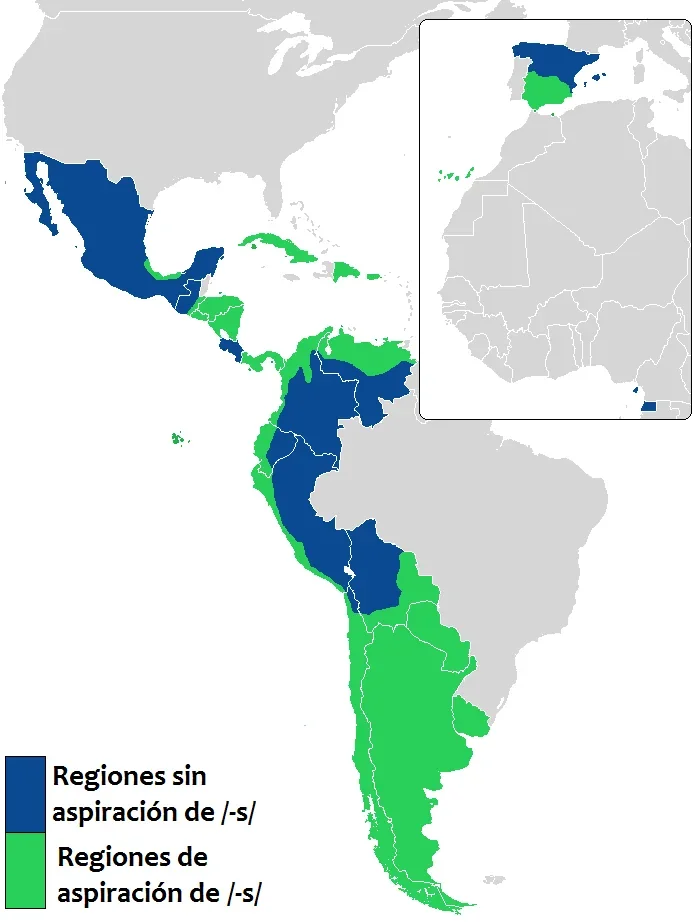
Distribution of coda /s/ aspiration in Spanish. Available online: https://www.reddit.com/r/Spanish/comments/lg8nxb/map_of_s_aspiration_or_reduction_of_spanish/. Accessed on 05/29/2026.
What Is /S/-Lenition?
The term lenition refers to the weakening or softening of a sound. In many dialects of Spanish, syllable-final /s/ may be:
fully produced
aspirated (e.g., “loh gato”)
omitted entirely (e.g., “lo gato”)
This phenomenon is known as /s/-lenition.
Importantly, this is not a rare or unusual speech pattern. /S/-lenition occurs across many varieties of Spanish, including:
Caribbean Spanish
coastal regions of Latin America
Canary Islands Spanish
southern Spain
It is less common in dialects from the Mexican highlands and many Andean regions of South America (Miller, 2014).
Another important point is that /s/-lenition is not random. Adult speakers vary their use of syllable-final /s/ based on multiple linguistic and sociolinguistic factors (Miller, 2014). For example:
omission is more common in informal contexts
word-final /s/ is omitted more often than word-medial /s/
speakers are more likely to maintain /s/ when it marks plurality
social factors such as region, gender, and socioeconomic context may also influence production patterns
Children exposed to these dialects are not hearing a perfectly consistent plural marker. Instead, they are hearing variable input from the very beginning.
And that variability matters for acquisition.
How /S/-Lenition Changes Plural Acquisition
Research suggests that children exposed to dialects with variable /s/ production acquire plural comprehension and production differently than children exposed to dialects where plural /s/ is consistently pronounced.
Children acquiring non-leniting dialects of Spanish often begin demonstrating plural comprehension around age 2–3 (Arias-Trejo et al., 2014; Pérez-Paz et al., 2015). However, studies of children exposed to /s/-leniting dialects found that stable comprehension may not emerge until closer to ages 4–5 (Miller, 2014).
Plural production and morphosyntactic agreement continue developing throughout early childhood, with some children still demonstrating errors on plural morphology tasks at age 6, particularly with lower-frequency -es forms (Lázaro et al., 2017; Miller, 2014).
That developmental range makes sense when we think about the role of input.
Children learn grammar by detecting patterns in the language around them. Every time they hear a grammatical form, it provides evidence about how the system works. But when the signal itself is inconsistent, acquisition naturally becomes more difficult.
If children sometimes hear:
“los gatos”
and other times hear:
“lo gato”
they have to determine which parts of the utterance are carrying grammatical meaning and which variations are acceptable within their dialect.
Research across languages consistently shows that variable input impacts grammatical acquisition timelines. Similar patterns have been observed in English dialects where grammatical morphemes are inconsistently marked (Arias-Trejo et al., 2014).
Why Traditional Assessment Can Be Misleading
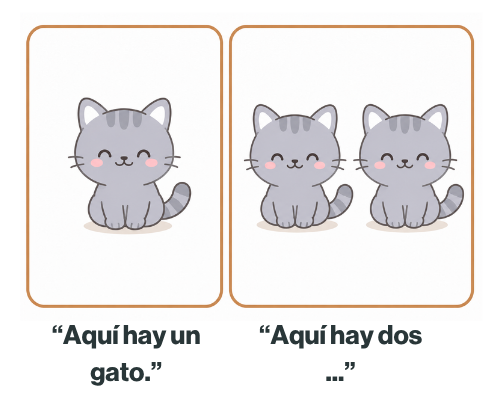
Wug Test based on Jean Berko’s research on plural morphemes
This is where assessment becomes especially complicated.
Many plural assessments use Berko- or Wug-style elicitation tasks where children are asked to produce plural forms independently:
“Here is one cat. Here are two ___.”
But for children who speak /s/-leniting dialects, omission of final /s/ may reflect dialectal phonology rather than morphosyntactic weakness.
Miller (2014) found that even children who understood plurality frequently omitted plural markers during these single-word elicitation tasks. Interestingly, performance changed when the task itself changed.
Children who demonstrated understanding of plural concepts omitted plural markers:
about 43% of the time during Berko-style elicitation tasks
but only about 25% of the time during repetition tasks (Miller, 2014)
Why might that happen?
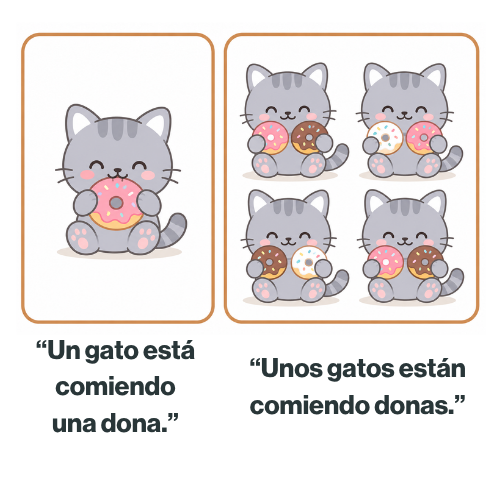
Semantic Repetition task where children are asked to repeat an entire sentence (Miller, 2014)
Because connected speech contexts more closely resemble natural adult input. Adult speakers are more likely to maintain plural marking within phrases and sentences than in isolated word productions.
For children who did not demonstrate plural comprehension, omission rates remained much higher during repetition tasks.
This distinction is clinically important.
A child may omit plural /s/ because:
they have not acquired the grammatical concept
their dialect weakens or omits syllable-final /s/
both factors are occurring simultaneously
Therapeutic Takeaways
When working with children exposed to /s/-leniting dialects:
Do not treat dialectal /s/-lenition as an error
Focus on comprehension and functional communication
Use phrase-level and sentence-level models rather than isolated nouns
Provide multiple morphosyntactic cues to support plurality
Be cautious applying English-informed expectations for morphology
Consider whether intervention targets reflect true disorder versus dialectal variation
It is also important to remember that omission of final /s/ may be phonological, morphological, dialectal, or a combination of all three.
That is why context matters so much.
Assessment Considerations
When assessing plural development in children exposed to /s/-leniting dialects:
Gather detailed dialect and language exposure information
Ask about family and community speech patterns
Listen to the parents’ speech!
Assess comprehension separately from production
Use repetition tasks alongside elicited production tasks
Collect connected speech samples whenever possible
Compare performance across contexts instead of relying on a single task
Be cautious interpreting omitted final /s/ before age 6
One of the most important clinical shifts is moving away from asking:
“Did the child say the -s?”
and instead asking:
“What does this child understand, and how does their dialect influence production?”
That shift leads to much more accurate and culturally responsive assessment.
Final Thoughts
Dialect has to be considered when looking at plural development in Spanish, or we risk confusing linguistic difference with language disorder.
Understanding /s/-lenition allows us to build assessments and interventions that are not only more accurate, but also more culturally and linguistically responsive for the children and families we serve.
References
Arias-Trejo, N., Cantrell, L. M., Smith, L. B., & Canto, E. A. A. (2014). Early comprehension of the Spanish plural. Journal of Child Language, 41(6), 1356–1372. https://doi.org/10.1017/S0305000913000615
Lázaro, M., Nieva, S., Moraleda, E., & Garayzábal, E. (2017). Procesamiento morfológico y formación del plural en niños con desarrollo típico. Didácticas Específicas, 8, 65–80. https://doi.org/10.15366/didacticas2013.8.004
Miller, K. (2014). Assessing plural morphology in children acquiring /s/-leniting dialects of Spanish. Language, Speech, and Hearing Services in Schools, 45(3), 173–184. https://doi.org/10.1044/2014_LSHSS-13-0032
Pérez-Paz, V. I., Arias-Trejo, N., & Alva, E. A. (2015). Importance of language and number of objects in plural distinction during infancy. Anales de Psicología, 32(3), 863–870. https://doi.org/10.6018/analesps.32.3.225521