Could Technology Help SLPs Support Bilingual Children?
What One Study Found About Spanish Audio Prompting
Technology is changing the way speech-language pathologists think about providing services to bilingual children.
Today, we have translation tools, text-to-speech applications (yay for language sample transcription!!), digital resources, and increasingly sophisticated AI tools that can generate and deliver content in multiple languages. But the question of how technology can help an SLP incorporate a child's home language into intervention is not new.
In fact, researchers were exploring this question years before today's AI boom. A 2019 study by Rivera Pérez and colleagues examined whether audio prompting in Spanish could help monolingual English-speaking SLPs provide bilingual vocabulary intervention to Spanish-speaking preschoolers.
The study offers an interesting early example of technology being used to provide linguistic support that the clinician did not personally have.
The Study: Can Audio Prompting Support Bilingual Vocabulary Learning?
The researchers studied 43 Spanish-speaking preschool children between 3 and 5 years old who were enrolled in a Head Start program. The children in this study had IQ and vocabulary skills within normal limits and passed a bilingual language screening.
The children were divided into three groups:
Control group: No vocabulary instruction
Spanish-English Instruction Group (SEIG): Vocabulary was taught in both Spanish and English, with Spanish provided through audio prompting
English-only Instruction Group (EIG): Vocabulary was taught in English only
The intervention lasted six weeks. Children participated in two 35-minute sessions each week, and four new vocabulary words were targeted each week. The target words included two nouns and two verbs selected as Tier 2 vocabulary for preschoolers. The words also had equivalents in both Spanish and English.
What Did the Audio Prompting Look Like?
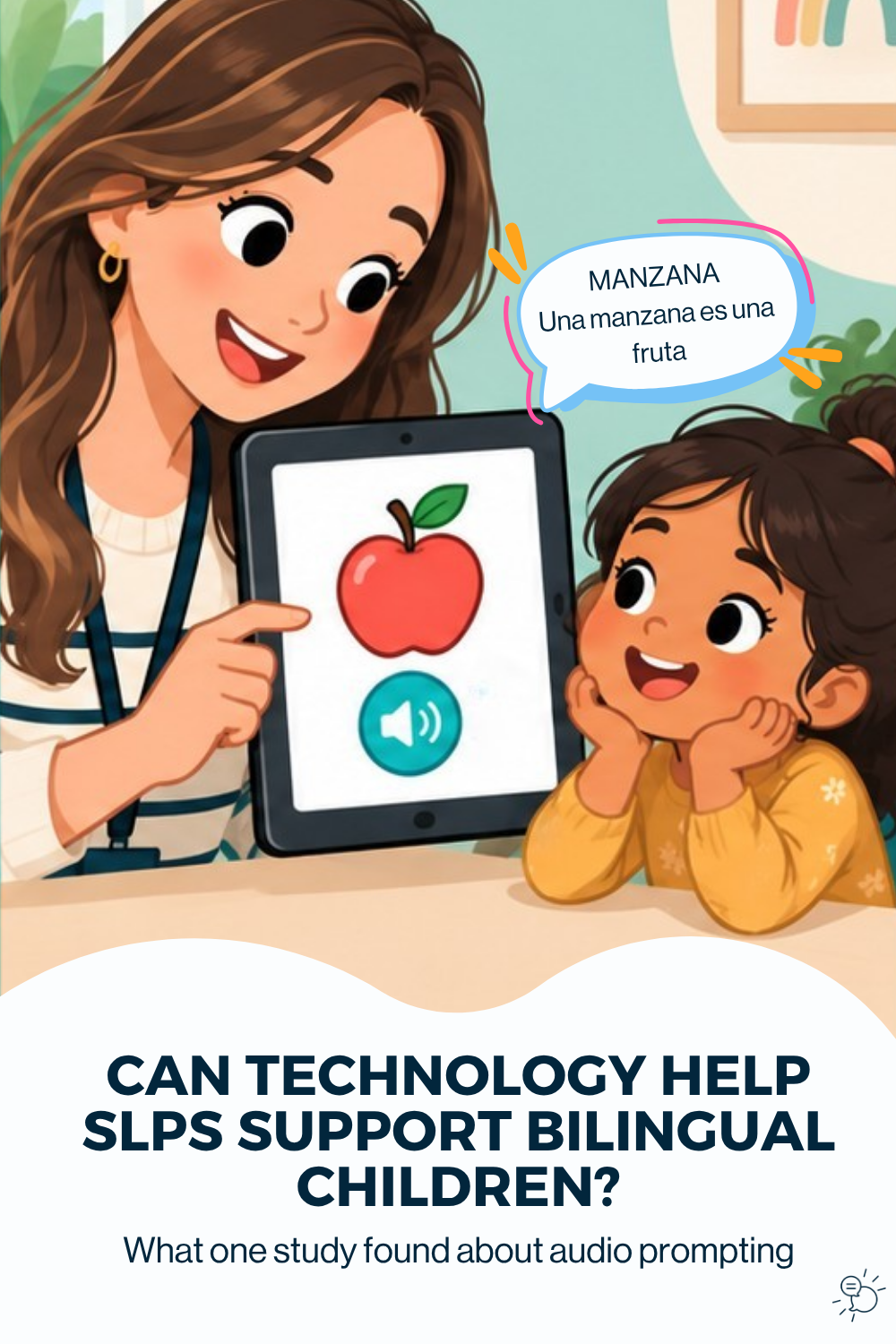
The SLPs in the study were monolingual English speakers, so the Spanish portions of the intervention were delivered through audio prompting on a tablet. For example, during vocabulary instruction, the clinician could show the child a photograph while the tablet provided the Spanish word and definition. The child and clinician could then practice the word together.
What Did the Researchers Find?
The researchers measured children's vocabulary knowledge in both English and Spanish, looking at two areas:
Naming: Could the child produce the word when shown a picture?
Definition: Could the child provide information about what the word meant?
Both intervention groups demonstrated significant gains in English naming and definition. The Spanish-English group also demonstrated significant gains in Spanish naming and definition.
At the six-week follow-up, both intervention groups maintained their English naming gains. The Spanish-English group also maintained gains in English definition. Children receiving Spanish-English instruction demonstrated growth across both languages, with some gains maintained after the intervention ended.
Was Spanish Helping the Children Learn English?
This is one of the most interesting questions raised by the study.
The results suggest that Spanish support may have functioned as a scaffold for vocabulary learning, rather than competing with English learning. The Spanish-English group showed gains in Spanish vocabulary while also making gains in English. The researchers found evidence of stronger English definition outcomes and Spanish vocabulary outcomes for the bilingual intervention group.
This is consistent with a broader understanding of bilingual language development: supporting a child's home language does not necessarily mean taking something away from the second language. Instead, the child's existing linguistic knowledge may provide a foundation for learning new concepts and vocabulary.
What Can SLPs Take Away From This Study?
This study shouldn't be viewed as a set of recommendations for how SLPs should use technology. It was a specific intervention with a relatively small group of preschool children who had typical cognitive and language skills. The study did not examine children with DLD, so we should be cautious about extending these findings to children with identified language disorders.
But it does give us some interesting possibilities to consider.
1. Technology might help reduce linguistic barriers.
A monolingual SLP may not be able to independently provide a Spanish language model.
In this study, technology provided access to specific Spanish language models while the SLP remained responsible for the intervention.
This raises an interesting possibility: Could technology help clinicians incorporate a child's home language into intervention when the clinician does not speak that language?
The study provides some preliminary evidence that this type of support can be incorporated into vocabulary intervention successfully.
2. Supporting Spanish doesn't have to mean abandoning English goals.
Children receiving Spanish-English instruction continued to make progress in English while also gaining Spanish vocabulary. The Spanish component was incorporated into instruction targeting Tier 2 vocabulary that was relevant in both languages.
3. The clinician’s expertise matters.
Perhaps the most important takeaway is that the technology did not replace the SLP.
The SLP was still responsible for selecting targets, explaining concepts, engaging the child, providing opportunities for practice, monitoring responses, providing feedback, and making clinical decisions. The technology provided linguistic support. The clinician provided the therapy.
That distinction becomes even more important as today's AI tools become more capable. An AI tool might generate a Spanish translation or produce a Spanish language model, but that does not mean it knows which vocabulary is clinically meaningful for a particular child, whether a translation is appropriate for the child's dialect and cultural context, or how that word should be incorporated into intervention.
Can technology give an SLP access to languages they don’t speak?
In 2019, the answer being explored was Spanish audio prompting. Today, technology can do much more. AI tools can generate text, translate languages, produce speech, and create materials in ways that were not readily available when this study was conducted.
But can AI-generated language models be accurate and developmentally appropriate? How well do they represent different Spanish dialects? Can they reflect the vocabulary and preferences of individual families? How should clinicians evaluate AI-generated content before using it with children?
We don't have all of those answers yet. So while using technology tools can help us incorporate other languages, we have to be cautious as the evidence here is still limited. This study is an interesting one in that is reinforces that bilingua interventions continue to be effective and that technology may have the potential to expand what clinicians can offer.
Disclosure Note: I currently work with the CABVI Lab, the team behind the study discussed here. I wasn't part of this study or its publication, this post reflects my own reading and interpretation of the research.
Reference
Rivera Pérez, J. F., Creaghead, N. A., Washington, K., Guo, Y., Raisor-Becker, L., & Combs, S. (2019). Using audio prompting to assist monolingual speech-language pathologists to teach English–Spanish vocabulary to English learners. Communication Disorders Quarterly, 41(1), 3–11. https://doi.org/10.1177/1525740118819659