Understanding Plural Marking in Spanish: What Makes It Different From English?
When we think about plural development, it’s easy to assume that Spanish and English work similarly because both languages commonly use an “-s” ending. But once you look closer, Spanish plural morphology operates quite differently.
In English, plural marking is less predictable phonologically and often carried only on the noun itself. In Spanish, plural information is repeated across articles, adjectives, nouns, and verbs. That means Spanish-speaking children are navigating a system with more redundancy—but also more agreement demands.
For SLPs, these differences matter. They influence how children learn plurals, what errors are developmentally expected, and how we interpret assessment performance.
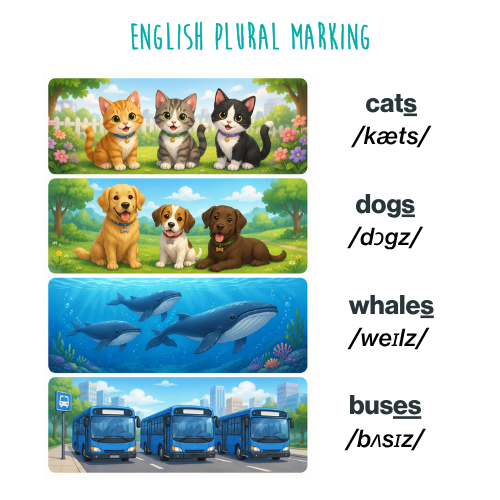
English plural marking changes pronunciation depending on the phonological context. Words like cats (/s/), dogs (/z/), and buses (/ɪz/) demonstrate the three primary English plural allomorphs. Also note the clusters for these common words.
How English Marks Plurals
In English, plural nouns are produced using three main allomorphic variations:
Adding /s/ (“cats”) after most words ending in unvoiced consonants or with –y (“babies”)
Adding /z/ (“dogs”) - after words ending in a voiced consonant
/əz/ (“buses”) - in words ending with –s, –x, –z, –ch, or –sh
(I’m referring to pronunciation patterns here, not spelling changes.)
One important feature of English pluralization is that it often creates more phonologically complex word endings. Words like cats or roads contain consonant clusters that can be difficult for young children to produce. Research has shown that phonological complexity impacts children’s plural production, particularly when pluralization results in complex codas or stop clusters (Arias-Trejo et al., 2014).
Because of this, children may demonstrate understanding of plurality before they consistently produce the plural morpheme. For example, a child might say “two dog” long before they consistently produce “two dogs.” In this case, the child may understand the concept of plurality but still have difficulty producing the full phonological form.
How Spanish Marks Plurals
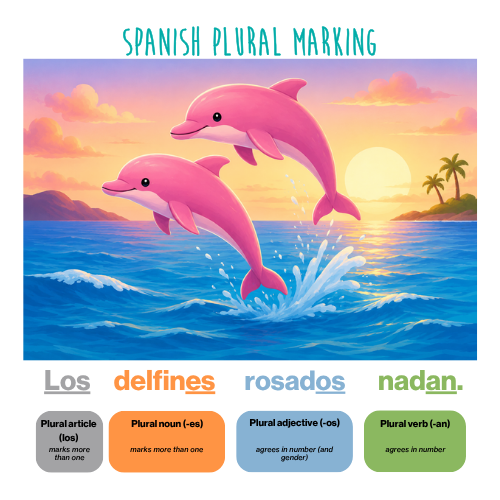
Spanish plural marking is distributed across multiple words within a sentence. In the phrase Los delfines rosados nadan, plurality is marked through the article, noun, adjective, and verb, providing repeated grammatical cues for Spanish-speaking children.
At first glance, Spanish pluralization may seem simpler.
In Spanish, plural nouns are typically formed using two endings:
-s after vowels (casa → casas)
-es after consonants or stressed vowels
Unlike English, most Spanish plural forms do not create difficult consonant clusters. In fact, approximately 84% of nouns in children’s early Spanish vocabulary use the easier -s plural form (Arias-Trejo et al., 2014). From a phonological standpoint, this often makes plural production somewhat easier in Spanish than in English.
But Spanish also introduces another layer of complexity: plural information is distributed across multiple words within a sentence.
Articles, nouns, adjectives, pronouns, and even verbs can all carry plural marking. A phrase like los delfines rosados nadan contains repeated cues that communicate plurality across the entire phrase.
On the one hand, this means children have more agreement relationships to learn. On the other hand, it also means Spanish-speaking children are exposed to repeated grammatical cues about plurality much more frequently than English-speaking children are (Pérez-Paz et al., 2015).
Rather than hearing plurality marked once, children may hear it repeated several times within a single phrase or sentence.
Why Input Matters
Children learn grammatical systems through repeated exposure and input. The more consistent and frequent the input, the stronger their internal understanding of the grammatical system becomes.
Research has shown that Spanish-speaking toddlers are better able to comprehend plurality when multiple morphosyntactic cues are available (Arias-Trejo et al., 2014; Pérez-Paz et al., 2015). For example, children around age 2 were more successful identifying plural meaning when they heard phrases containing several plural markers compared to situations where only the noun carried the plural cue.
In other words, hearing something like:
“Son unas ponas”
provided stronger support for understanding plurality than hearing only:
“ponas”
This idea also extends beyond language itself and into the visual information children receive.
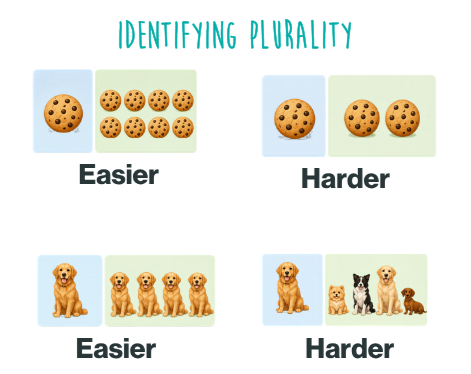
Children more easily identify plurality when quantity contrasts are larger (1 vs. 8 cookies) and when items are visually identical (1 dog vs. 4 identical dogs). Smaller quantity differences and more varied items can make plural concepts more difficult to distinguish.
Studies examining plural comprehension found that children more easily distinguished plurality when shown large quantity contrasts, such as 1 object versus 8 objects, compared to smaller contrasts like 1 versus 2 (Pérez-Paz et al., 2015). Similarly, children performed better when shown identical objects rather than groups of similar-but-not-identical items.
That distinction is important clinically.
When children are exposed to too many changing features at once, they have to determine which information is actually meaningful. Are the objects different because there are more of them? Because they belong to different categories? Because they look different?
Reducing variability initially may help children focus specifically on the concept of plurality itself.
Therapeutic Takeaways
If we want children to learn plurality, it makes sense to make the signal as strong and consistent as possible.
When working on plurality in Spanish:
Use phrases and sentences rather than isolated nouns
Provide multiple plural cues across articles, verbs, and nouns
Start with highly frequent and functional -s forms
Use visually obvious quantity contrasts initially
Begin with identical objects before introducing more varied categories
Gradually increase complexity:
larger quantity contrasts -> smaller quantity contrasts
identical items -> similar but non-identical items
As children develop a stronger understanding of plurality, we can gradually introduce more variable examples and more subtle contrasts.
It is also important to remember that children are not simply memorizing an “-s” ending. They are building an understanding of how plurality functions across an entire grammatical system.
Final Thoughts
Plural development in Spanish is not simply an “easier” or “harder” version of English. It reflects a different grammatical system with different learning demands, different cueing patterns, and different developmental pathways.
And once we understand how Spanish plural marking works, the next question becomes: when do children actually acquire it?
That’s exactly what we’ll explore in the next post.
References
Arias-Trejo, N., Cantrell, L. M., Smith, L. B., & Canto, E. A. A. (2014). Early comprehension of the Spanish plural. Journal of Child Language, 41(6), 1356–1372. https://doi.org/10.1017/S0305000913000615
Lázaro, M., Nieva, S., Moraleda, E., & Garayzábal, E. (2017). Procesamiento morfológico y formación del plural en niños con desarrollo típico. Didácticas Específicas, 8, 65–80. https://doi.org/10.15366/didacticas2013.8.004
Pérez-Paz, V. I., Arias-Trejo, N., & Alva, E. A. (2015). Importance of language and number of objects in plural distinction during infancy. Anales de Psicología, 32(3), 863–870. https://doi.org/10.6018/analesps.32.3.225521