When Do Spanish-Speaking Children Learn Plurals?
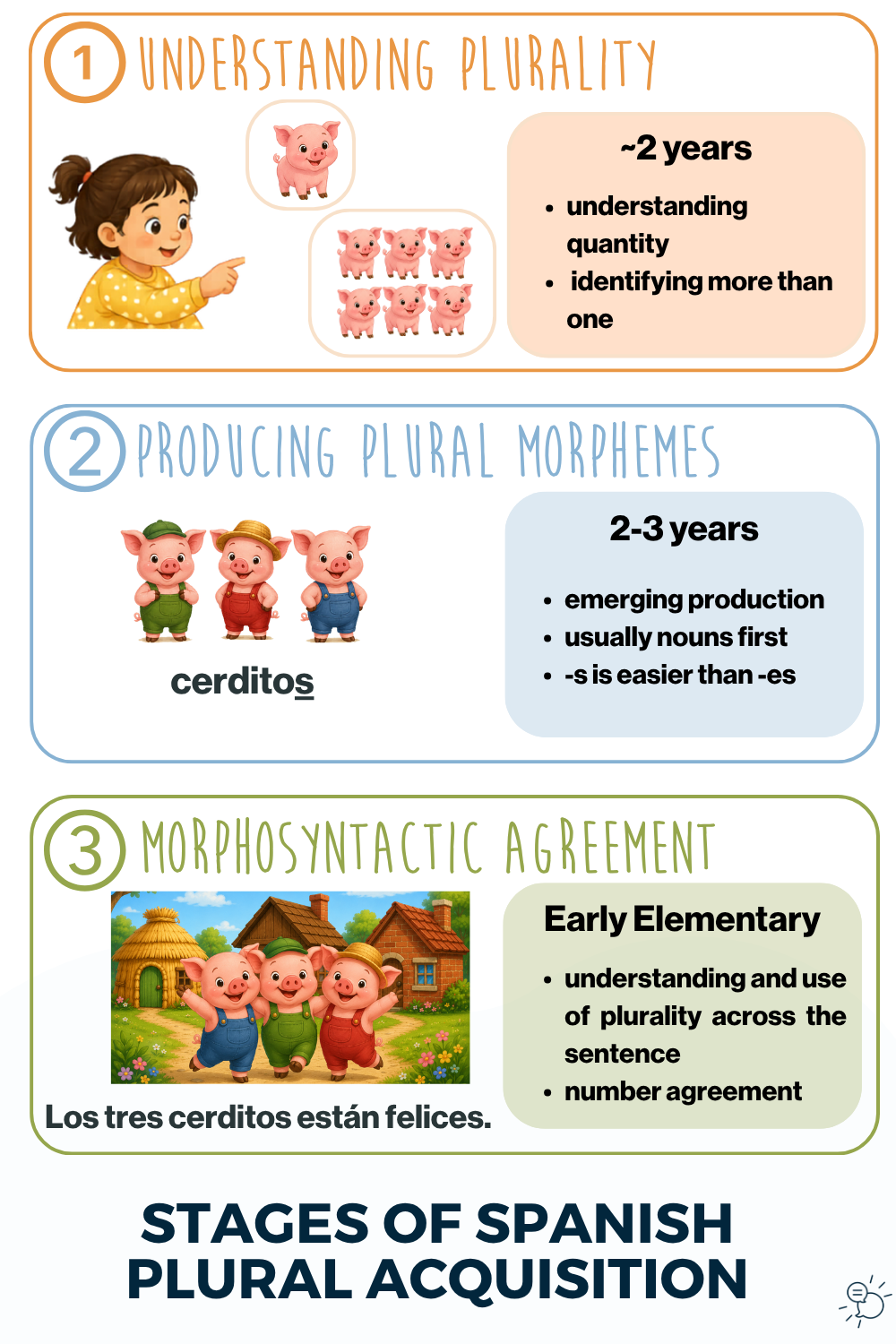
Spanish plural acquisition develops gradually across several stages. Children first learn the concept of “more than one,” then begin producing plural morphemes on nouns, and eventually learn to coordinate plural agreement across entire sentences.
After looking at how plural marking works in Spanish, the next question becomes: when do children actually acquire it?
Plural acquisition develops gradually across several stages. First, children have to understand the concept of “more than one.” Then they begin producing plural markers on nouns. Finally, they learn how plural agreement works across entire phrases and sentences.
This developmental process is important for SLPs to understand because children may demonstrate strengths in one area of plural development while still struggling in another. A child may understand plurality before they consistently produce plural markers. They may produce plural nouns but still demonstrate inconsistent agreement across articles, adjectives, or verbs.
Understanding these stages helps us interpret errors more accurately and avoid expecting mastery before the system is developmentally established.
Stage 1: Understanding the Concept of Plurality
Before children can consistently produce plural markers, they first need to understand the concept of plurality itself.
This may sound obvious, but plurality is actually a fairly abstract concept. Children have to learn that language can represent quantity and that certain grammatical markers communicate “more than one.”
Research suggests that comprehension of plurality begins relatively early in Spanish-speaking children. Studies of Mexican Spanish-speaking toddlers found that many children around age 2 were able to distinguish singular from plural forms when given strong morphosyntactic cues (Arias-Trejo et al., 2014; Pérez-Paz et al., 2015).
For example, children performed better when they heard phrases such as:
“Son unos gatos”
rather than hearing only:
“gatos”
In other words, the multiple plural markers across the sentence helped strengthen the meaning of plurality.
The visual information children receive also matters. Studies found that children more easily distinguished plurality when presented with larger quantity contrasts, such as 1 object versus 8 objects, compared to smaller contrasts like 1 versus 2 (Pérez-Paz et al., 2015). Similarly, children performed better when shown identical objects instead of groups of similar-but-not-identical items.
This likely happens because children are still trying to determine which features are meaningful. If too many variables are changing at once, children may have difficulty identifying that the important feature is number.
Importantly, comprehension typically develops before stable production. A child may fully understand plurality while still inconsistently producing plural markers in speech.
Stage 2: Producing the Plural Morpheme
Once children begin understanding plurality conceptually, they start producing plural morphology.
Research suggests that Spanish-speaking children begin using plural forms somewhere between approximately 1;9 and 2;6, depending on the study and the specific skill being measured (Lázaro et al., 2017). However, early production is often inconsistent.
Children generally acquire the highly frequent -s plural earlier than -es forms. This makes sense when we consider the structure of Spanish. Around 84% of nouns in children’s early Spanish vocabulary use the -s plural form, while -es occurs much less frequently (Arias-Trejo et al., 2014).
The more often children hear a grammatical pattern, the stronger that pattern becomes within their developing language system. This is one reason why high-frequency forms are often acquired earlier and more consistently.
Studies have also found that children perform better with real words than pseudowords during plural tasks (Lázaro et al., 2017). Familiar vocabulary likely provides stronger lexical support, while nonsense words require children to rely more heavily on abstract morphological rules.
Clinically, this mirrors what many of us see in therapy. Children often become accurate with high-frequency and highly familiar patterns before they generalize the rule to less familiar contexts.
Stage 3: Learning Morphosyntactic Agreement
Producing plural nouns is only one part of the system.
Spanish also requires children to coordinate plural agreement across multiple parts of a sentence. Articles, adjectives, pronouns, and verbs may all need to agree in number.
This means children are not only learning to attach an “-s” to the end of a noun. They are learning how plurality functions across an entire grammatical structure.
Research suggests that agreement between articles and nouns tends to emerge before agreement between nouns and verbs (Lázaro et al., 2017). During development, children may produce partially correct forms such as:
las casa
la casas
These productions show that children are beginning to understand the system, even if they are not yet consistently coordinating all elements correctly.
Importantly, plural development continues longer than many people expect.
Some studies found that children younger than 6 years still demonstrated errors with both -s and -es plural forms (Lázaro et al., 2017). Even at age 6, some children continued to show difficulty with lower-frequency -es forms, while performance improved significantly by age 8.
This highlights an important point: emergence does not equal mastery.
Children may begin using plural forms quite early while still refining the system for several years afterward.
Why Plural Acquisition Takes Time
Plural development requires children to coordinate several different skills simultaneously:
understanding the concept of “more than one”
producing the correct sound pattern
applying morphological rules
coordinating agreement across sentence elements
That is a lot of linguistic work packed into what looks like a very small grammatical marker.
Cross-linguistic research also reminds us that plural acquisition timelines vary significantly across languages. Languages with more irregular plural systems often demonstrate longer developmental trajectories.
For example:
German plural acquisition may continue through approximately age 5
Some Arabic plural systems demonstrate development into adolescence (Lázaro et al., 2017)
Even within Spanish, frequency and consistency of input strongly influence acquisition patterns.
Therapeutic Takeaways
When supporting plural development in Spanish:
Teach the concept of plurality, not just the morpheme
Use strong visual contrasts initially
Start with highly frequent -s plural forms
Use repetitive phrase-level models
Use real words before pseudowords or nonsense words
Expect agreement errors during development
Explicitly teach lower-frequency -es forms as children progress
It is also important to think about where the breakdown is occurring.
If a child is inconsistently producing plurals, we should ask:
Is this a conceptual issue?
A phonological issue?
A morphosyntactic agreement issue?
Those are very different intervention targets.
Assessment Considerations
When assessing plural development in Spanish-speaking children:
Assess comprehension separately from production whenever possible
Do not assume lack of production means lack of understanding
Consider developmental stage when interpreting errors
Be cautious interpreting -es errors in younger children
Use language samples alongside elicited tasks
Look for emerging agreement patterns across phrases and sentences
Children may demonstrate partial knowledge of the plural system long before they fully master all aspects of it.
Closing
Spanish plural acquisition is a long developmental process rather than a single milestone.
Children first learn what plurality means, then how to mark it morphologically, and finally how to coordinate agreement across sentences.
But even these developmental timelines can shift depending on the dialect of Spanish a child is exposed to.
In the next post, we’ll look at how plural acquisition changes in Spanish dialects with /s/-lenition—and why that distinction matters so much for assessment and intervention.
References
Arias-Trejo, N., Cantrell, L. M., Smith, L. B., & Canto, E. A. A. (2014). Early comprehension of the Spanish plural. Journal of Child Language, 41(6), 1356–1372. https://doi.org/10.1017/S0305000913000615
Lázaro, M., Nieva, S., Moraleda, E., & Garayzábal, E. (2017). Procesamiento morfológico y formación del plural en niños con desarrollo típico. Didácticas Específicas, 8, 65–80. https://doi.org/10.15366/didacticas2013.8.004
Pérez-Paz, V. I., Arias-Trejo, N., & Alva, E. A. (2015). Importance of language and number of objects in plural distinction during infancy. Anales de Psicología, 32(3), 863–870. https://doi.org/10.6018/analesps.32.3.225521